Amazon Sidewalk is no longer a future feature. It is already live — quietly — in Canadian homes.
The rollout is happening in two phases. Ring devices went live on January 27, 2026, while Echo and Alexa-enabled devices will join on February 26, 2026, unless users actively disable the feature. Together, these devices form what Amazon calls a “secure community network,” designed to keep devices connected beyond the limits of home Wi-Fi.
The language is calm. The promises are modest. But Sidewalk represents a meaningful shift in how home internet connections, security hardware, and smart assistants are expected to function — not just individually, but collectively.
So the real questions are straightforward: Is Amazon Sidewalk actually secure? And will it meaningfully affect your home network?
What Amazon Sidewalk Actually Is
Amazon Sidewalk is a low-bandwidth, long-range network that allows certain Ring and Alexa devices to act as network bridges. These bridges use Bluetooth and sub-GHz radio frequencies to extend connectivity to compatible devices when Wi-Fi is unavailable, out of range, or temporarily disrupted.
In simple terms, Sidewalk allows devices to stay online by borrowing a small amount of internet connectivity from nearby homes. Your devices may rely on your neighbors’ connections, and your connection may do the same for theirs.
The data involved is intentionally small. The architectural change is not.
Is Amazon Sidewalk Secure?
Yes — Sidewalk is secure by consumer IoT standards. There is no evidence that it exposes personal data, allows neighbour's access to your network, or meaningfully weakens home security.
Amazon uses multiple layers of encryption, device authentication, and account separation. Sidewalk traffic is encrypted end-to-end, and devices connected through Sidewalk cannot see each other or access local home networks. From a technical standpoint, this is competent, modern engineering.
Where the debate begins is not encryption, but control and visibility.
Sidewalk introduces a permanent background networking service that does not appear in router logs, cannot be inspected by users, and is managed entirely through firmware and cloud controls. Users cannot see Sidewalk traffic, monitor usage in real time, or apply granular security rules. Participation is all-or-nothing.
That does not make Sidewalk unsafe — but it does mean that security depends entirely on trust in Amazon’s implementation, updates, and long-term policy decisions.
Why Ring Going Live First Matters
 The decision to activate Sidewalk on Ring devices before Echo speakers is not trivial.
Ring products are security devices. They are always on, often battery-backed, and positioned at the boundary between private property and public space. From a network design perspective, they are ideal anchors: outdoors, widely distributed, and close to neighbors.
By starting with Ring, Amazon ensured that Sidewalk would quickly gain strong, street-level coverage. That improves resilience and reliability — but it also means that the first layer of Sidewalk infrastructure is built on devices many people associate primarily with home security, not networking.
For some users, that distinction will matter.
What Impact Will Sidewalk Have on Your Internet?
In practical terms, Sidewalk’s bandwidth impact is negligible. Amazon caps usage per household, and the amount of data involved is small enough that most users will never notice any change in speed or performance.
However, Sidewalk traffic is:
-
Persistent, not occasional
-
Invisible to users
-
Unmetered by local network tools
-
Enforced by Amazon, not by your router
For households with unlimited broadband, this is largely academic. For those using rural, fixed-wireless, LTE, or metered connections, the lack of transparency may be more concerning than the volume of data itself.
The key issue is not how much bandwidth Sidewalk uses — it is that users have no way to see or manage it.
Does Sidewalk Increase Risk?
Sidewalk does not expose files, devices, or local networks. It does, however, expand the number of pathways through which a home participates in a broader system.
Any always-on service increases theoretical attack surface, even when well designed. Amazon has mitigated that risk through encryption and isolation, but it has also removed user-level oversight. The trade-off is intentional: convenience and resilience in exchange for transparency and control.
For many households, that is an acceptable trade. For others, it is not.
Location Data and “Approximate” Tracking
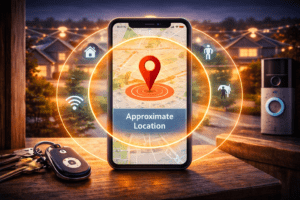 Sidewalk uses approximate location data derived from proximity and signal strength. It does not provide precise GPS coordinates, and users cannot track one another directly.
Still, approximate location data gains significance over time. Repeated signals can reveal patterns about where devices tend to be, when they move, and which homes act as stable network anchors. This information remains abstract for most users — but it is another layer of passive data generation that operates by default.
So Is Amazon Sidewalk Safe?
Yes — Amazon Sidewalk appears to be secure, low-impact, and responsibly engineered. There is no evidence it meaningfully degrades internet performance or compromises personal data.
But it is also:
-
Automatically enabled
-
Opaque to users
-
Dependent on long-term trust in Amazon
-
Designed to function best when participation is widespread and passive
That combination makes Sidewalk less a technical issue than a philosophical one.
How to Turn Amazon Sidewalk Off
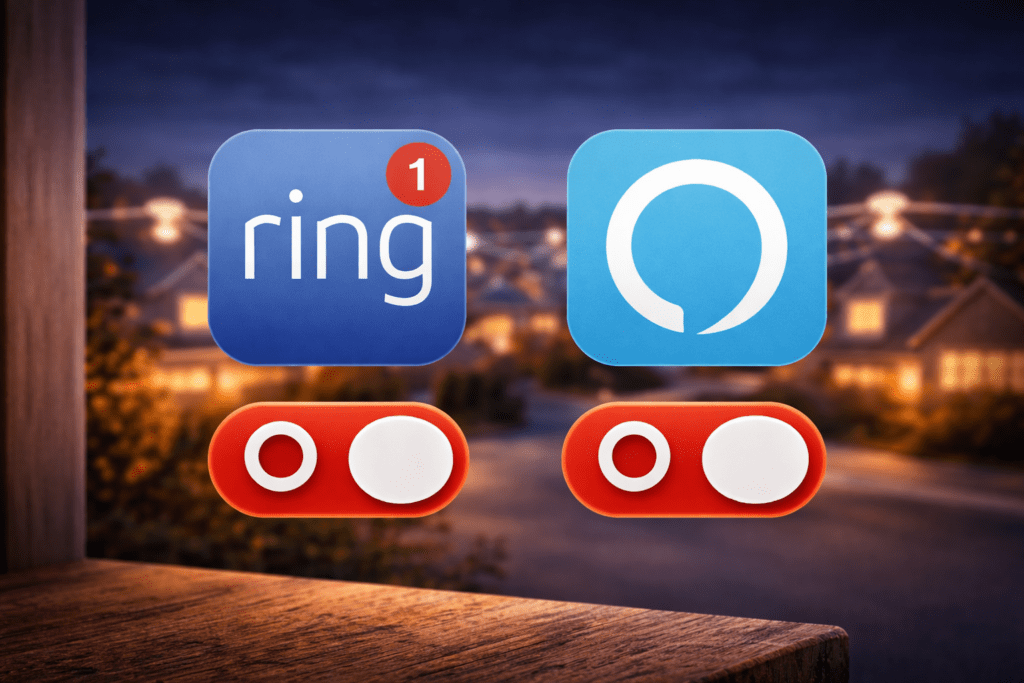 Users who prefer not to participate can disable Sidewalk at any time. Because Ring and Echo devices are managed separately, both apps should be checked — especially if accounts are linked.
Ring devices
-
Open the Ring app
-
Go to Control Center
-
Select Amazon Sidewalk
-
Toggle Sidewalk Off
Echo / Alexa devices
-
Open the Alexa app
-
Tap More
-
Go to Settings
-
Select Account Settings
-
Tap Amazon Sidewalk
-
Toggle Sidewalk Off
Once disabled, your devices will no longer act as Sidewalk bridges.
A Quiet but Important Shift
Amazon Sidewalk is not dramatic, invasive, or immediately disruptive. That is precisely why it deserves attention. It reflects a broader move toward shared, neighbourhood-scaled connectivity built on private homes and consumer hardware.
Whether that future feels reassuring or uncomfortable depends on how much control you want over your network — and how much trust you are willing to place in platforms that increasingly operate in the background.
What matters most is not whether Sidewalk is on or off, but that the decision is made deliberately — not by default.
You can read other opinion articles on the blog page. You may also enjoy The Ordinary Effect Podcast, video content of The Monthly Social Podcast on YouTube or The Path Radio Mix on YouTube.